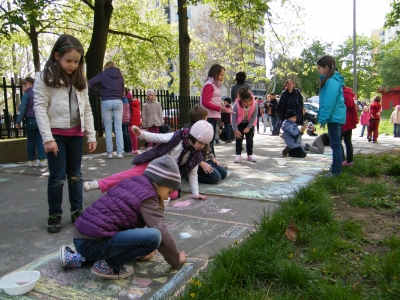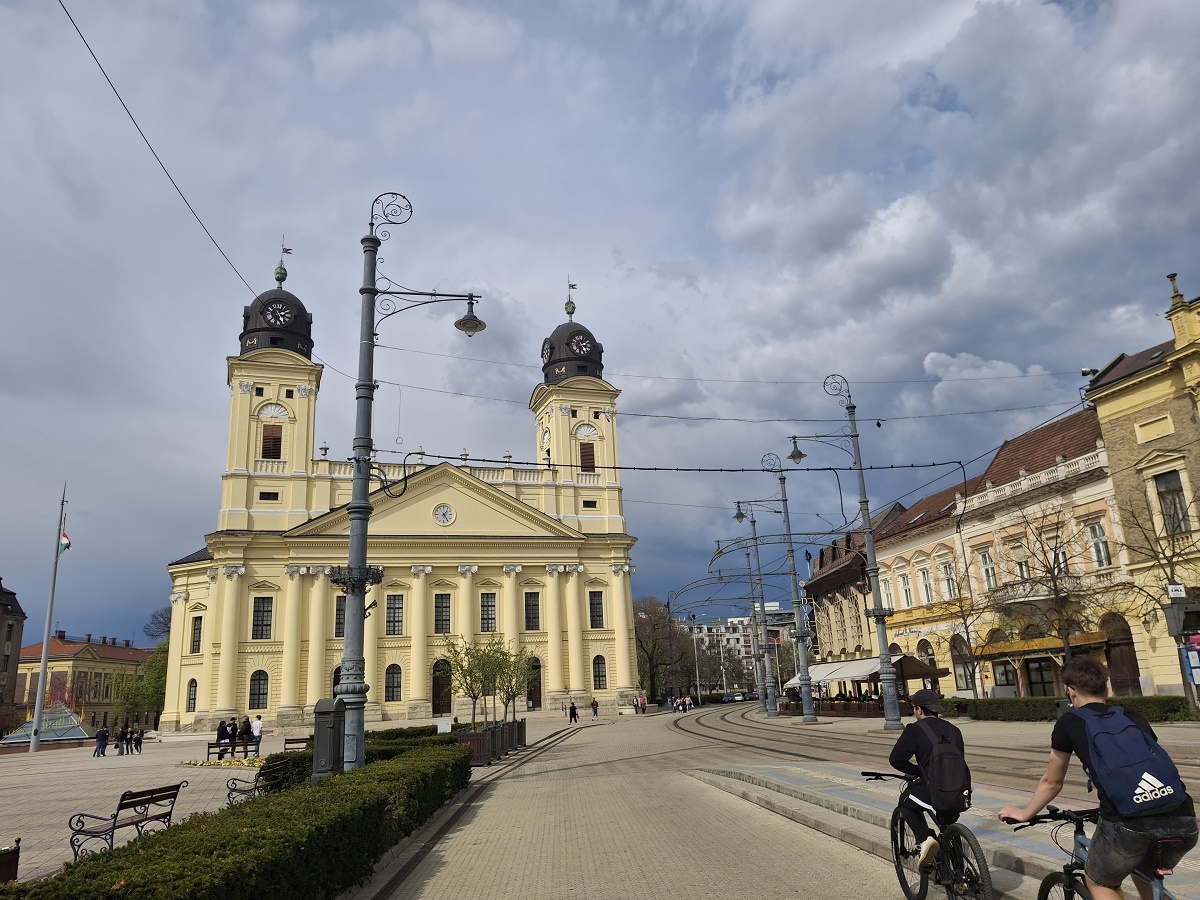
At the Szikra Movement’s political festival, “Lobbanáspont,” environmental activist Éva Kozma, president of the Mikepércs Mothers for the Environment Association, Debrecen activist Anikó Papp, and ecological economist Mihály Dombi, the local leader of Szikra, discussed environmental challenges and the future of Debrecen. The speakers analysed the potential downsides of Debrecen’s major industrial investments through a framework based on the five classical elements: water, air, earth, fire and trust.
Water: dwindling reserves
The discussion, titled “What will happen to you, Debrecen?”, began with the region’s water situation, which has already become a tangible reality in the daily lives of local residents. Éva Kozma pointed out that while every summer people hear that the current year is the coolest in the years to come, rainfall has been declining dramatically, grass and gardens are drying out, and residents are already limiting the watering of tomatoes in their home gardens as part of efforts to conserve water collectively. In stark contrast, large-scale water consumption and treatment continue throughout the summer in the Southern Industrial Park.
The seriousness of the situation is illustrated by the fact that 18 kilometres of dedicated water pipelines have so far been built to serve the factories, while in some outlying parts of nearby Mikepércs – for example, around the Mészáros Gergely Garden, formerly known as Gugyori – residents still lack basic access to a piped drinking water network.
An analysis of water balances also showed that water extraction from the Keleti Main Canal increased by 30% in 2025 compared with previous years, due to the major industrial investments.
Mihály Dombi said he was angry about Debrecen’s industrial policy and pointed to the dangerous crossing of ecological planetary boundaries, including those related to freshwater use and nutrient cycles. He also argued that electric vehicle manufacturing, presented as a “green solution,” is in fact an unsustainable dead end.
Éva Kozma added that waste processing has not even begun yet, and depending on the method used, it could consume enormous amounts of water or energy.
Air: Debrecen has the second-highest level of air pollution in the country
Debrecen’s air quality is among the worst in the country, partly due to the city’s geographical location in a basin and unfavourable wind conditions, Anikó Papp explained. She said the situation had already concerned her 20 years ago, and in recent years it has been compounded by the 8–9 major industrial investments established in the city. She said she sees no intention on the part of the city leadership to improve the situation. In fact, she has reached the point where she prefers taking the bus instead of walking because, during the heating season, air pollution can be so high that spending time outdoors can have health effects comparable to those of smoking a cigarette every hour, Papp said, illustrating the severity of the situation.
Éva Kozma drew attention to the carcinogenic effects of particulate matter and noted that air pollution data can be monitored on the MIAKÖ website.
The city’s Green Code also came under serious criticism:
- The contrast between plans and reality: The document’s analysis accurately identifies the problems and, on paper, promises a 50% reduction in carbon dioxide emissions by 2030. It notes, for example, that road traffic was originally the largest source of air pollution. However, according to the speakers, political decision-makers ultimately rewrite strategic plans to serve the interests of industrialisation, while the actual emissions of factories are often not even included in the calculations.
- The missing protective forests: While legislation and previous industrial regulations stipulated that a protective forest at least 40 metres wide, consisting of dense deciduous and coniferous trees, should be planted around major industrial facilities to filter soot, odours and noise, the speakers said these requirements have not been applied around Debrecen’s battery factories. They also said that most of the 10,000 trees planted in the city in recent years have died or become stunted due to a lack of water and maintenance.
Mihály Dombi said he personally knows some of the people who participated in drafting the Green Code and has a fairly good idea of how the process may have unfolded. He recalled that the city of Debrecen has strategic documents both as a legal requirement and on its own initiative, including the Sustainable Urban Mobility Plan (SUMP) and the Green Code.
He said he believes the entire process is like something out of a meme: a Fidesz politician comes “like a high-speed train” and overrides the entire situation analysis according to political interests. A 200-page, sound scientific analysis is simply overturned by declaring that greywater will now be needed to supply the Southern Industrial Park, and this is then added to the code without difficulty.
Dombi described it as outrageous and astonishing that logical, objective human thinking is being pushed into the background by what he called mindless industrialisation. He stressed that there is actually no need to invent anything new; instead, the city should implement what is already set out in its own situation analysis and develop policies to put those recommendations into practice. He said that this is precisely what the Szikra Movement wants to do in Debrecen: solve the problems, eliminate sources of air pollution and improve the city’s air quality. According to Dombi, this does not require miracle solutions or electric cars, but rather a functioning public transport system with suburban rail, as well as support for heating equipment used by people in need, since established and effective methods already exist for addressing these issues.
The land: concrete jungle, heat islands and Forum 2
Looking back briefly at the drying up of lakes around Debrecen, which has had a devastating impact on the city’s microclimate, Dombi Mihály spoke about how the proportion of built-up areas in Hungary has increased dramatically, by around 30%, over the past decades. In Debrecen, this trend has been even more pronounced. According to the latest modelling calculations by MATE (Hungarian University of Agriculture and Life Sciences), a single square metre of open, living soil has enough natural cooling capacity to replace 13–15 hours of operation by the air conditioner of an average apartment. By contrast, the concrete surfaces spreading across the city, including large-scale developments planned in the heart of the city centre and roads with excessive numbers of lanes, permanently destroy soil life and significantly increase summer heat.
The issue of the Forum 2 development in the city centre was also raised. In a speech, a local resident expressed outrage that the project is expected to result in the removal of the beautiful 50-year-old chestnut trees standing in the former nursery school yard next to the police station. The development also threatens the community fruit-sharing garden due to increased traffic and the planned increase in the permitted building coverage to 100%.
In connection with this, Dombi Mihály made a firm promise: through cooperation between the Szikra Movement and the informal Civis Házakért civic group, they will organise a human chain to protect the trees and use every legal and physical means available to prevent the destruction of green spaces in the city centre.
Energy: enormous demand and global contradictions
The energy needs of Debrecen’s giant factories and the infrastructure serving them have reached unprecedented levels. Kozma Éva pointed out that the plans have continued to expand: the 40-gigawatt-hour capacity originally planned for the first phase of CATL’s operations has, following modifications, moved closer to 60 GWh, which also carries the risk of further capacity expansions.
She also referred to earlier warnings by energy expert Attila Holoda, who said that conventional grids would be unable to meet such enormous energy demand, meaning that small modular reactors (SMRs) could become a serious consideration in the future.
Addressing energy and resource management, Dombi Mihály pointed out that while the quality of water, soil and air is strictly a local issue – these are the resources that local communities actually possess – energy is a global commodity, as a significant proportion of electricity and fuels is imported and can even be sourced from other continents.
In this regard, he highlighted two important factors:
The illusion of renewable energy: While he supports the use of renewable energy sources and replacing conventional sources wherever possible, he stressed that we should not fall into the misconception that renewables alone will save us. He cited the example that although Hungary is a world leader in the pace at which solar energy is being adopted, and harmful emissions are also falling significantly in more developed Scandinavian countries, the environmental burden – the amount of resources consumed, the proportion of land covered with concrete and the decline in biodiversity – is increasing at exactly the same rate as before.
Energy consumption and happiness: Dombi also pointed out that people do not become happier simply by consuming more energy. There is no apparent limit to energy demand or technological ingenuity, yet people do not become more satisfied as a result. As an example, he noted that nearly one-third of young people in Britain struggle with some form of mental illness despite having unlimited access to energy. At the same time, we have become more isolated, and genuine community spaces have disappeared; as he put it, even in the heart of Debrecen, keeping a hospitality venue operating is a serious struggle.
The Debrecen president of Szikra argued that instead of unlimited growth and ever-increasing energy demand, we should examine what we actually need and shape our lives accordingly, because what we need is not more energy, but a more sustainable approach.
Kozma Éva recalled two of her favourite statements:
“A just green transition” – which is neither just nor green.
“We know it pollutes locally, but it is green globally” – a phrase she borrowed from Balázs Szilágyi, CATL’s head of public affairs.
Trust: a crisis of credibility and civic solidarity as a last chance
The fifth and most important topic of the evening was trust. Trust between residents and the city leadership, as well as in official measurements, is at an all-time low. A striking example was the earlier nickel contamination case, when, after authorities and the factory had denied the issue, it emerged that nine workers had nevertheless been found to have four times the normal level of heavy-metal exposure.
Because of scepticism towards official bodies, residents now place their trust primarily in the work and measurements of independent civic organisations such as the Mikepércsi Anyák (Mothers of Mikepércs) and the Civis Házakért group. Papp Anikó and Kozma Éva agreed that the only real response to external pressure is community solidarity: if residents are able to join hands, put aside their divisions and stand together for the place where they live, the ecological dead end threatening Debrecen’s future may still be prevented.