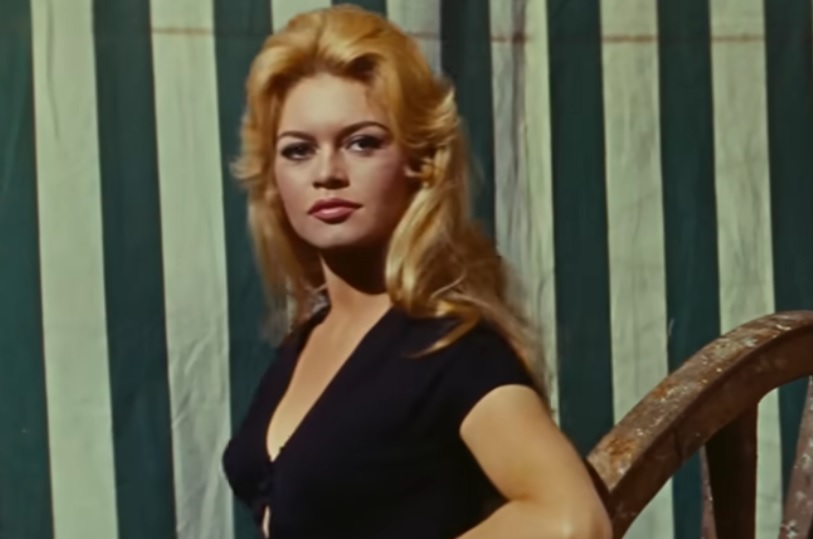
Brigitte Bardot, the legendary French film actress, female icon of the 1960s, and devoted defender of animals, has died at the age of 91 at her home in southern France, the animal welfare foundation she founded and which bears her name announced on Sunday.
The statement recalls that the internationally acclaimed actress and singer decided to give up her glittering career in order to devote her life and energy to the protection of animals and to her foundation. The announcement does not specify the exact date of her death. The film diva was hospitalized last month.
The “divine BB,” the sex symbol of the 1950s and 1960s, said farewell to filmmaking more than fifty years ago, leaving behind around fifty films. She turned 91 on September 28.
According to a compilation by the Press Archive of the National Archives:
Brigitte Anne-Marie Bardot was born in Paris and raised in a well-to-do, conservative Catholic family. Her parents insisted on good manners, proper clothing, careful choice of friends, and a solid education.
From the age of five she was enrolled in music and dance classes; her mother envisioned a future graceful ballerina in her, while Brigitte herself saw a way out. At the age of sixteen, she was already smiling from the cover of Elle magazine with her charming, slightly cheeky teenage face. This was how director Roger Vadim discovered her for film; despite strong opposition from her parents, he married her in 1952 and turned her into a star.
It was from him that she learned her pout was irresistible, her body dressed in tight jeans and daring bikinis was provocative, and that she posed perfectly in front of the camera. They made nine films together, and their relationship lasted five years.
The young beauty first stepped in front of the camera in 1952 during the filming of The Norman Hole, and after a brief overseas excursion — in 1953 she appeared in Hollywood alongside Kirk Douglas in Act of Love — she continued filming in her homeland.
After several forgettable roles in forgettable films, her first truly defining Bardot film was made in 1956, directed by her husband: And God Created Woman. Alongside her co-star Jean-Louis Trintignant, both rose to stardom.
In the opening scene of the film, Brigitte Bardot lying naked on her stomach embodied pure temptation, and her barefoot dance on a table is considered by many to be one of the most erotic scenes in film history.
Bardot’s cheeky nudity, which made her the embodiment of the sexual revolution, thoroughly enraged moral guardians. Following scathing criticism, the film flopped at home, but American audiences flocked to theaters.
Life magazine wrote: “Since the arrival of the Statue of Liberty in 1886, no French girl has electrified Americans quite like this.” By presenting female sexuality in a natural, erotic way, the ash-blonde Bardot greatly enhanced the reputation of French cinema. Eventually even her more prudish compatriots softened, and in 1970 the bust of Marianne — the symbol of France displayed in public institutions — was modeled on her features for the first time.
Over a career spanning 21 years, she made nearly fifty films. The 1959 adventure film Babette Goes to War relied heavily on her charm; she considered The Truth (1960) her best film; A Very Private Affair (1961), co-starring Marcello Mastroianni, contains autobiographical elements. Her most versatile performance came in Jean-Luc Godard’s 1963 film Contempt.
For the American film Dear Brigitte, the crew came to her, as she did not wish to travel to the United States. In 1965 she appeared in Louis Malle’s Viva Maria! alongside Jeanne Moreau, followed by Masculin Féminin, another major Godard film. In 1968 she starred opposite Sean Connery in the western Shalako.
As a singer, she released five studio albums and dozens of singles, the most famous being Bonnie and Clyde (1968), recorded with Serge Gainsbourg and hugely popular in France. (Their classic song was rerecorded in 2011 by Scarlett Johansson with Gainsbourg’s son.)
Bardot was passionate in her private life as well. Many men enjoyed her charms, and even more were linked to her by rumor. After Vadim, her husbands included actor Jacques Charrier, with whom she had a son in 1960, then German billionaire playboy Günter Sachs for three years, and since 1992 politician Bernard d’Ormale.
She shot her last film, Don Juan, in 1973, after which she devoted all her time to animal protection. She had animals from childhood; by her own account, love for animals saved her during her lowest moments, and as an activist she sought to repay that devotion. In 1986 she founded the Brigitte Bardot Animal Welfare Foundation, of which she remained a tireless advocate.
In defense of animals, she knew no limits: she mobilized thousands against bullfighting, saved elephants from euthanasia, protested American bear hunting and Japanese whaling, animal experimentation, cruel slaughterhouse practices, and the shooting of foxes in France. She welcomed France’s 2021 animal rights law banning the use of wild animals in circuses as a major step forward.
With her sharp tongue, she criticized politicians and fellow artists alike. In a 2018 statement, she described today’s actresses as ugly and poorly dressed, lacking elegance and failing to inspire dreams.
After her retirement, she continued to stir controversy through her public stances, supporting the legalization of euthanasia and recognition of the right to assisted suicide. She was accused of racism and xenophobia over her statements, convicted several times, and expressed sympathy for the National Rally party led by Marine Le Pen.
The name Brigitte Bardot became a myth: songs were written about her, ships named after her, books devoted to her life. She lived in Saint-Tropez, where a statue also commemorates her. Her memoir was published in Hungarian in 2018 under the title Tears of Struggle.
Just as she did in her youth, she accepted herself in old age as well, never undergoing plastic surgery, saying: “Why pretend you’re young when you’re not?”
(MTI)