


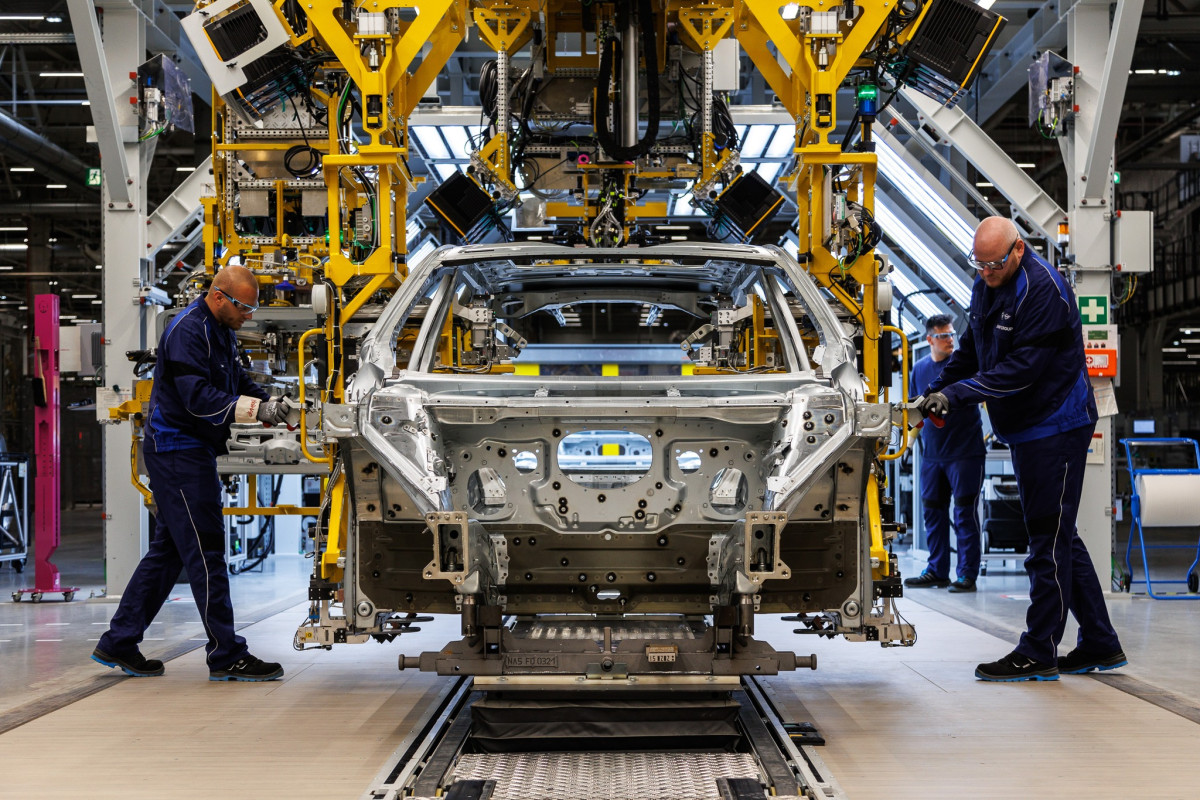
According to Schmidt, the model is performing far better than expected, which is why a second production shift was introduced at the Debrecen plant already in February, earlier than originally planned. This will also have a positive impact on employment, although he did not provide further details.
He emphasized that the success of the Debrecen factory could also positively influence investments and the development of supplier networks across the Central and Eastern European region. The Hungarian production site proves that internationally competitive electric vehicles can also be manufactured in Europe, he said.
He also recalled that the BMW iX3 produced in Debrecen — the first member of the Neue Klasse model family — has won several prestigious automotive awards, including Hungary’s Car of the Year 2026 award, as well as the global World Car of the Year and World Electric Vehicle of the Year titles.
The vice president reaffirmed that the company chose Debrecen because of its proximity to European markets, its established supplier ecosystem, and the availability of a highly skilled workforce. He added that Hungary’s decades of automotive manufacturing experience also played an important role in the investment decision.
He stressed that the BMW Group does not support tariffs or other trade restrictions against Chinese competitors, although it considers the establishment of balanced competitive conditions important. In his view, the Chinese market is characterized by extremely strong competition and innovation, which contributes to technological progress and maintaining global competitiveness.
Glenn Schmidt highlighted that technological neutrality remains fundamentally important for BMW. The company aims to meet all customer needs, which is why its portfolio includes gasoline and diesel vehicles, plug-in hybrids, fully electric vehicles, and hydrogen-powered models alike.
He pointed out that this technological openness and flexibility provide stability and continuity for the company in a changing market and regulatory environment, while also taking into account differing consumer demands and market regulations.
Referring to changes in the European regulatory environment, he underlined that the automotive industry requires predictable long-term strategic directions.
He explained that one of BMW’s key strategic principles is to serve major markets through local production whenever possible, while recognizing that the industry itself operates globally. More than 85 percent of the vehicles BMW sells in China are manufactured locally. In the United States, the company established its South Carolina plant thirty years ago; today it is BMW’s largest factory and produces roughly half of the cars sold on the American market.
Responding to an MTI question about expected consolidation processes in the automotive industry, Schmidt said that one characteristic of the sector is that the leading automaker in a given region is usually a local manufacturer over the long term.
As examples, he mentioned that in the United States this role is filled by Ford and General Motors. In China — where significant consolidation is expected in the near future — a Chinese manufacturer is also likely to hold the largest market share, while in Europe a local manufacturer may likewise remain at the forefront.
In his presentation before the press briefing, held as part of the Transport Research Arena 2026 conference, Glenn Schmidt emphasized that sustainability and competitiveness reinforce one another.
He stressed that the BMW Group remains committed to achieving net-zero emissions across its entire value chain by no later than 2050, in line with the goals of the Paris Agreement. He added that clear and comprehensive sustainability targets can provide companies with a long-term competitive advantage.
According to Schmidt, approximately 70 percent of a vehicle’s value comes from suppliers. BMW works with around 2,700 first-tier suppliers worldwide, while tens of thousands of second- and third-tier partners are connected to the supply chain. The company encourages its partners to adopt circular economy solutions and renewable energy sources, he said.
In his opinion, operations based on the circular economy represent the only sustainable long-term direction for Europe, and strengthening this approach is essential to preserving the continent’s competitiveness.
During a panel discussion following the presentation, Schmidt said that in China, the share of plug-in hybrid and fully electric vehicle sales has risen above 50 percent even though the country has not set a goal of complete electrification and has not banned internal combustion engines. Instead, it built up its automotive industry through targeted industrial policy and support for local manufacturers and suppliers.
By contrast, in Europe, currently only about one in five new vehicles is electric, despite the introduction of strict regulations aimed at achieving full electrification, he noted.
Photo: Facebook/BMW Debrecen


