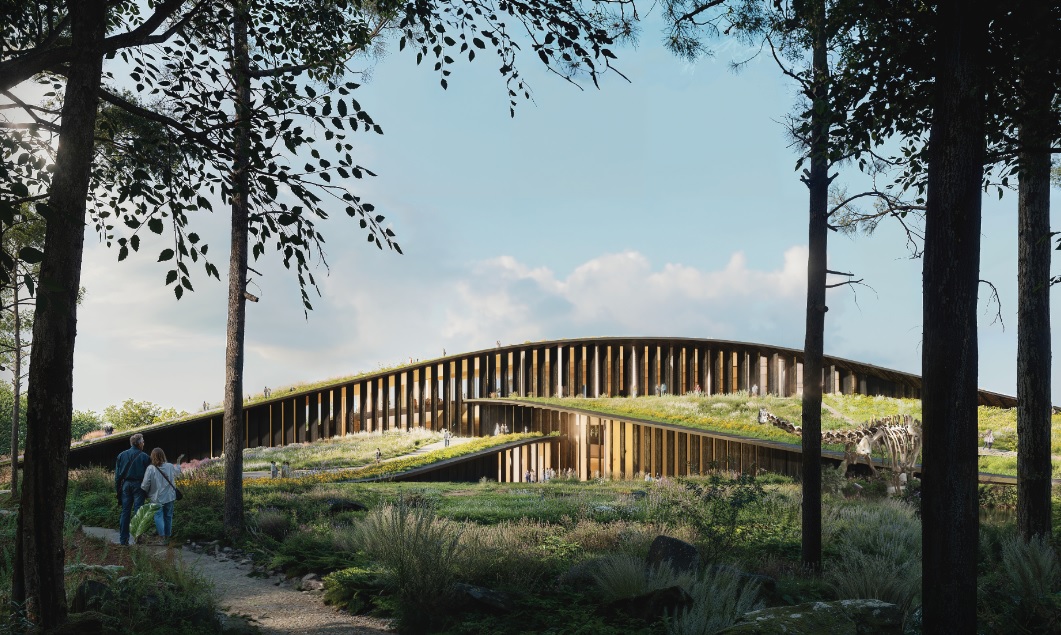
The exhibition building designed for the Hungarian Natural History Museum in Debrecen’s Big Forest (Nagyerdő) by the Bjarke Ingels Group (BIG) and the Hungarian Vikár and Lukács Architectural Studio has won two awards in the international finals of the Architizer A+Awards. According to the competition’s website, the project received the Jury Award in the category of Unbuilt Landscape Architecture and the Popular Choice Award in the category of Unbuilt Institutional Projects.
The international jury praised the design for its successful balance between nature and the built environment.
According to the architects’ earlier description, the 23,000-square-metre complex, planned for the site of the former stadium in the Big Forest, would function largely as an interior garden. Its green roof, covered with native vegetation, would naturally extend the forest canopy.
The building’s shape and massing are designed to blend organically into its surroundings, minimizing visual impact while encouraging the return of local wildlife and plant species. The entrance hall and garden would serve as an open public meeting place, accessible free of charge even outside opening hours, transforming the exhibition building into a new type of community space.
An international design competition for the project was launched by Debreceni Infrastruktúra Fejlesztő Ltd., and was won by the Danish Bjarke Ingels Group and the Hungarian Vikár and Lukács Architectural Studio. Their vision combines exhibition space, ecological symbolism, and a community venue, presenting the relationship between humanity and nature in a new dimension.
Responding to a question from the Hungarian News Agency (MTI), Ferenc Kun, Managing Director of Debreceni Infrastruktúra Fejlesztő Ltd., said that the fact both architecture professionals and future visitors selected the project from among hundreds of entries submitted from more than 80 countries demonstrates that “we have successfully completed a carefully prepared project that we can rightfully be proud of and that is ready for implementation.”
He added that the building’s first exhibition is planned to be organized by the Hungarian Natural History Museum. Preparatory work is being carried out in close cooperation with the institution, which would be the first to occupy the exhibition spaces once construction is completed.
Kun also noted that in contemporary international museum practice, exhibitions are often presented across multiple locations, even in different regions, while collection management and research activities do not necessarily take place at the same site. As a result, a modern, experience-based, and innovative exhibition venue can independently host high-quality scientific and cultural programmes while operating as part of a broader professional network.
“The concept of the new building creates an opportunity to realize a project—and ultimately a facility—that could in the future accommodate not only natural science exhibitions but also transport, innovation, and broader educational content, thereby strengthening the cultural diversity and educational role of eastern Hungary,” Kun emphasized.
The international competition for the Big Forest exhibition building was announced after the previous Hungarian government decided to relocate the Hungarian Natural History Museum to Debrecen. However, during his ministerial hearing, Zoltán Tarr, Minister for Social Relations and Culture in the Tisza government, stated that professionally unjustified museum relocations would be halted with immediate effect.
In May, Zsolt Bernert, Director General of the Hungarian Natural History Museum, confirmed in an interview with Index that the institution would not be relocating to Debrecen after all. At the same time, he suggested that a network model could be a positive development, meaning the museum could maintain exhibition venues in both Debrecen and Veszprém.
The Architizer A+Awards, which attracts participants from more than 80 countries, aims to recognize the world’s most outstanding architectural projects.
Now in its 14th edition, the competition’s international jury of more than 250 experts evaluated architectural projects and concepts across more than 120 categories, ranging from cultural institutions and public buildings to urban development concepts and sustainable, innovative architectural solutions.
The awards recognize projects that not only demonstrate architectural excellence and aesthetic value but also make meaningful social, environmental, and professional contributions to communities and the future built environment.
The Architizer A+Awards Popular Choice Winner is selected based on thousands of votes cast by members of the international public.
(MTI)