


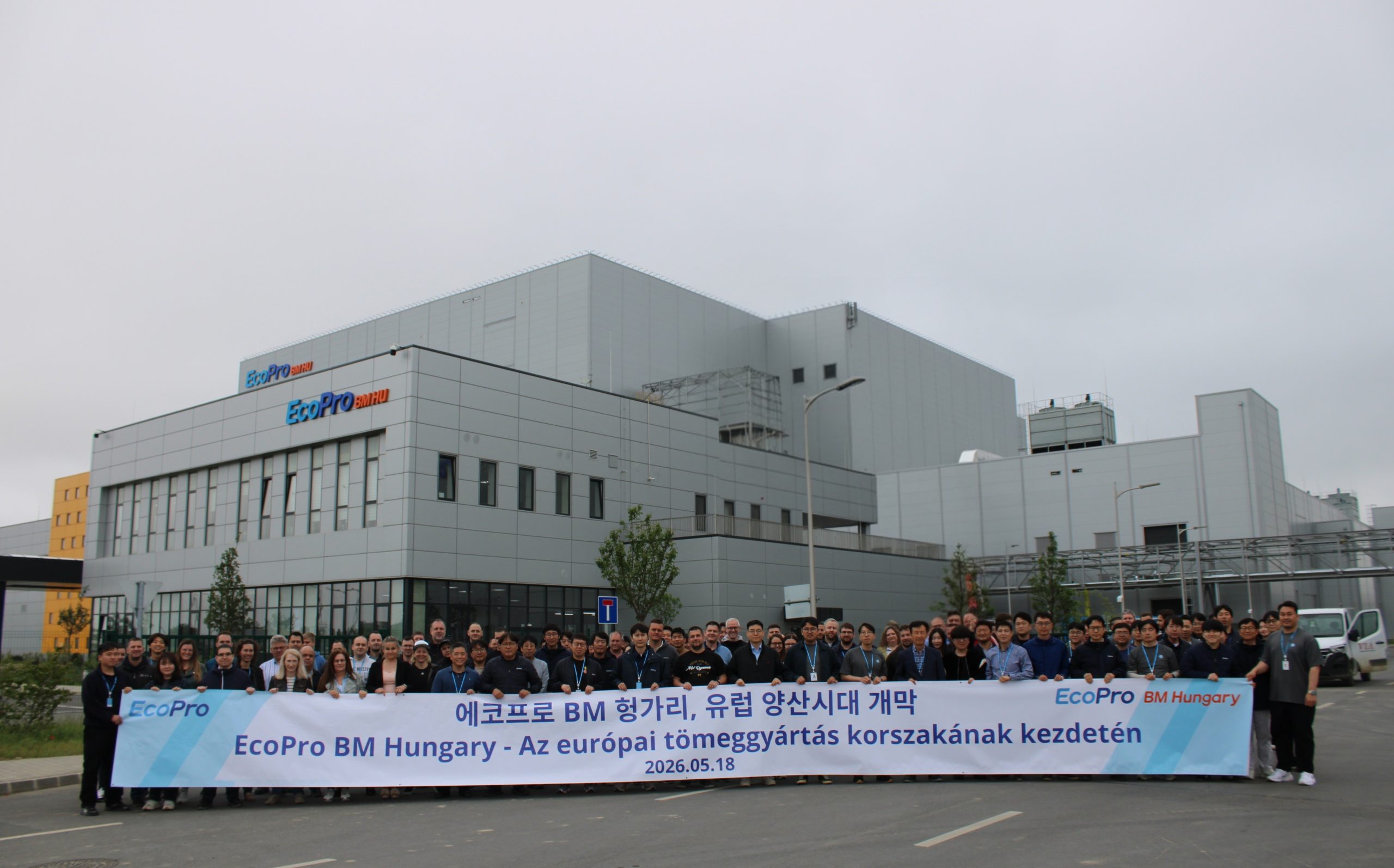
EcoPro BM Hungary Ltd., part of South Korea’s EcoPro Group, began mass production at its cathode material plant in Debrecen on May 18, 2026, marking the company’s first manufacturing base in Europe.
The investment is designed not only to strengthen Europe’s electric mobility supply chain but also to meet the strictest environmental and industrial safety standards. Sustainability, technological innovation, and responsibility toward local communities are at the heart of the facility’s operations. As another milestone for the project, the plant recently completed its first shipment of finished products, signaling the successful ramp-up of production and integration into the international supply chain.
South Korea-based EcoPro, one of the leading players in the cathode materials market and a key supplier to the global electric vehicle industry, has reached another milestone in expanding its European presence through the Debrecen investment. Operated by EcoPro BM Hungary Ltd., the facility is the company’s first European plant producing cathode materials for lithium-ion batteries, making it a key contributor to strengthening Europe’s battery value chain. The investment aligns closely with the European Union’s industrial policy objectives, particularly the goals of the Critical Raw Materials Act (CRMA), which aims to reinforce European supply chains. Local production enhances supply security while improving the competitiveness of European industry.
The approximately 44-hectare industrial complex is built around the integrated operation of three technological units. EcoPro BM manufactures cathode materials, EcoPro Innovation is responsible for lithium processing, and EcoPro AP produces industrial oxygen and nitrogen. The facility currently has an annual production capacity of 54,000 tonnes, enough to supply approximately 600,000 electric vehicles.
Environmental protection is one of the fundamental pillars of the company’s operations. During both the design and operation of the facility, all processes were developed with the goal of achieving the lowest possible environmental footprint, while systems continue to be upgraded and modernized in line with technological advancements.
The highly automated production systems not only ensure quality and efficiency but also minimize environmental impact. Most raw material handling, mixing, and drying processes take place in closed systems, ensuring that emissions remain controlled and below regulatory limits. Modern technologies are used to separate and filter gases and dust particles, while continuous monitoring helps protect the surrounding ecosystem.
The company’s strict operational framework is further demonstrated by its possession of an Integrated Environmental Permit and an industrial safety permit under the SEVESO Directive. These permits require extensive impact assessments and risk analyses and ensure the highest standards for handling hazardous materials and controlling emissions.
Safety measures have also been strengthened through practical implementation. Before trial production even began, the company established its own on-site fire brigade, providing continuous presence and specialized expertise to enable immediate intervention when necessary. In addition, EcoPro follows training practices that exceed legal requirements: industrial safety and emergency preparedness training sessions are conducted every six months instead of annually and are complemented by regular drills to ensure employee readiness.
Continuous improvement of environmental performance remains a key operational objective. Building on experiences gained during trial production and incorporating newly available technologies, the company regularly optimizes its processes. Air quality protection measures include accredited measurements at emission sources and continuous internal monitoring. Although measured values were already in compliance with legal limits, the company introduced higher-efficiency modern HEPA filters before launching mass production, further reducing emissions.
In water management, a monitoring well system ensures continuous oversight of groundwater quality, while a separate stormwater network and an in-house industrial wastewater treatment system help minimize environmental impact. Through water recycling and reuse solutions, daily drinking water consumption has been reduced by approximately 4,000 cubic metres, representing a significant step toward sustainable operations. Noise protection is also subject to continuous monitoring through systems installed at multiple points across the site to ensure compliance at all times.
To protect employee health, production takes place in a strictly controlled environment. In NCA production units and laboratories, the use of full-body and respiratory protective equipment is mandatory. Production areas operate under a “black-and-white” zoning system that separates clean and potentially contaminated areas. Employees undergo regular biological exposure testing, carried out more frequently than required by law.
For EcoPro BM Hungary, integration into local communities and supporting regional development are of strategic importance. The company aims to recruit a significant portion of its workforce from Debrecen and surrounding settlements, providing long-term and predictable employment opportunities for local residents. Through training programs, the company contributes to strengthening modern industrial expertise in the region while offering a stable and attractive working environment.
The Debrecen facility of EcoPro BM Hungary demonstrates how advanced industrial production, strict environmental and industrial safety compliance, and corporate social responsibility can reinforce one another. In the long term, the investment is expected to play a significant role in the sustainable development of Europe’s battery industry.
(EcoPro)


