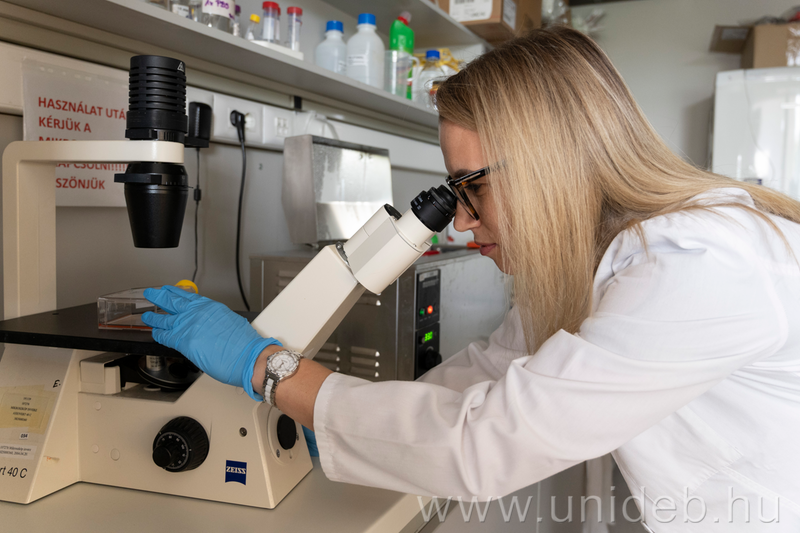
Magdolna Szántó, a researcher at the University of Debrecen, has successfully secured funding through the Momentum (Lendület) Programme of the Hungarian Academy of Sciences. The assistant professor won HUF 188 million to establish a research group aiming to develop a new therapeutic approach for psoriasis.
“Being among the winners of the Momentum Programme is a great honor and arguably the highest recognition for a young researcher in Hungary today, but it also comes with huge responsibility. I feel that if the outstanding professionals who evaluated the proposals have placed their trust in me, I have a duty to repay that by successfully completing the project. I will do my best to achieve this and hope it will succeed. One thing is certain: we are entering an exciting period,” Szántó told hirek.unideb.hu. She is an assistant professor at the Institute of Medical Chemistry at the University of Debrecen’s Faculty of Medicine.
Her winning project, titled “Immunometabolic dysregulation in psoriasis: From mechanisms to targeted therapies,” will investigate the links between metabolic states and inflammation pathways characteristic of psoriasis. The team is especially interested in questions such as: Why does obesity worsen psoriasis symptoms? Why are psoriasis patients more likely to develop metabolic disorders like obesity, diabetes, and cardiovascular diseases?
“These are very intriguing questions, as psoriasis is typically seen as a skin disease and, more broadly, as a kind of autoimmune disorder. However, these links with metabolic diseases suggest to me that the immune state of patients is fundamentally determined by which metabolic pathways are active in their cells, whether immune cells or skin cells. And the metabolism of individual cells is shaped by the overall metabolic state of the body, which includes diet and gut microbiota composition. Conversely, it’s also possible that immune cell dysfunctions—perhaps genetically driven—reprogram cell metabolism, leading to production of substances that trigger cascades affecting the entire body,” Szántó explained.
In summary, the research group is shifting the perspective: instead of approaching psoriasis purely from the immune system’s side, they propose that metabolic changes precede and influence the immune dysfunctions seen in the disease.
“Our goal is to propose a new therapeutic approach to treating psoriasis. Traditional therapies rely on immunosuppressants that broadly dampen immune overactivity, which also affects healthy immune functions and leads to side effects. We aim to identify therapeutic targets in the metabolic pathways that underlie immune dysfunctions. That way, immune problems might be treated through metabolic reprogramming—without immunosuppression,” Szántó emphasized.
Szántó has been a researcher for sixteen years, with a focus on dermatology-related topics for about nine years. Her career-long work has revolved around the PARP enzyme family, known both in cancer therapy and for its key regulatory roles in metabolism. Her team already knows that PARPs are involved in inflammation processes in skin cells, and with the Momentum grant, they will examine these mechanisms in greater depth.
“What makes our topic choice decisive is that we’re not just randomly looking for therapeutic targets in immunometabolism—we have very specific candidates. Our preliminary data suggest that the PARP enzyme family plays a central role at the intersection of immune and metabolic regulation. Proving this is our first task, but we hope to map out this complex network and identify more potential targets along the way,” she added.
Szántó emphasized that assembling a strong research team is crucial for success. Moreover, experts in dermatology, immunology, and metabolism must be involved. The HUF 188 million grant allows the group to recruit highly trained and experienced researchers. The official presentation of Momentum grant certificates is expected in fall 2025.
(unideb.hu)