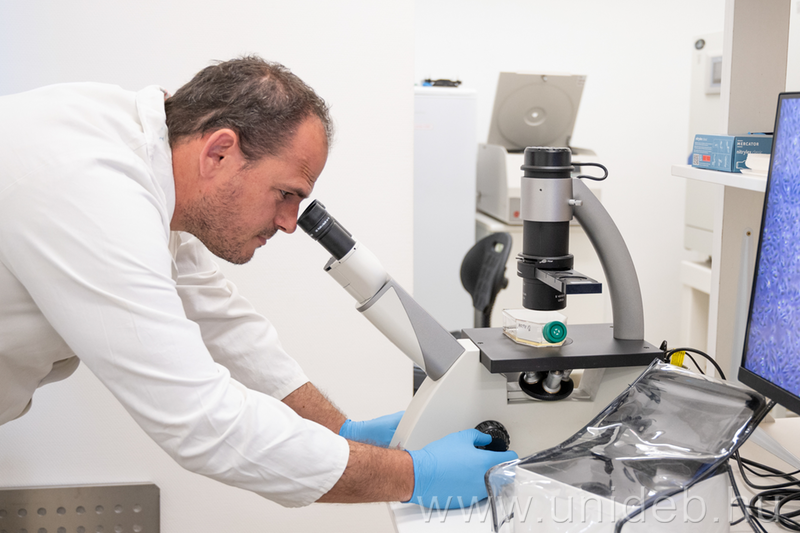
New therapeutic opportunities for treating abnormal blood vessel formation may become available thanks to research conducted by experts at the University of Debrecen. Abnormal vascularization in the retina plays a key role in the development of numerous eye diseases. The researchers observed during their study that this process can be inhibited by certain active substances. Their findings were published in a prestigious international scientific journal, and the article received the Publication Award from the Count István Tisza Foundation for the University of Debrecen and the University of Debrecen.
“Neovascularization, the formation of new blood vessels, plays a central role in the pathomechanism and development of several eye diseases, such as retinopathy of prematurity (ROP), age-related macular degeneration, and diabetic retinopathy. If left untreated, these conditions can lead to severe vision loss or even irreversible blindness. Our goal was to determine whether there is a connection between neovascularization and retinal hemorrhage,” said Tamás Gáll, senior scientific associate at the Institute of Internal Medicine, University of Debrecen, in an interview with hirek.unideb.hu.
Gáll explained that the study began with the collection of patient data. Based on the clinical data, a correlation between retinal hemorrhage and abnormal neovascularization was suspected. The next step in the research was to determine whether hemorrhage alone could trigger abnormal blood vessel formation in laboratory conditions.
“Our study spanned three years and included both clinical data collection and in vitro laboratory experiments. Our results showed that hemoglobin and heme, released during hemorrhage, cause hypoxic reprogramming of the retina’s pigment epithelial (RPE) cells. As a result, these cells produce elevated levels of pro-angiogenic factors that stimulate endothelial cell-driven vessel formation. We also found that this process can be inhibited using certain active compounds, which opens the door to new therapeutic options for treating abnormal neovascularization,” summarized the University of Debrecen researcher.
The findings were published in the journal Redox Biology, and the authors were honored with the Publication Award from the Count István Tisza Foundation for the University of Debrecen.
“This recognition is an honor. It reassures the researcher that they are on the right path and that their work is valuable. It also motivates the entire team to continue and aim for new goals,” emphasized Tamás Gáll.
In addition to researchers from the Institute of Internal Medicine, students and PhD candidates, as well as ophthalmologists and neonatologists from the University of Debrecen, contributed to the study. Experienced professionals from the National Institute of Oncology and the University of Pécs also supported the research. The team continues its work and is currently focusing on mapping signaling pathways and identifying therapeutic targets relevant to treatment.
(unideb.hu)