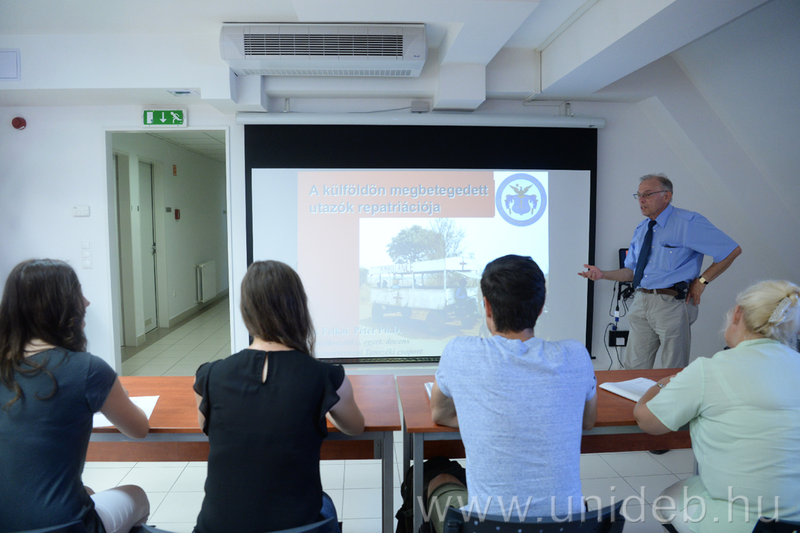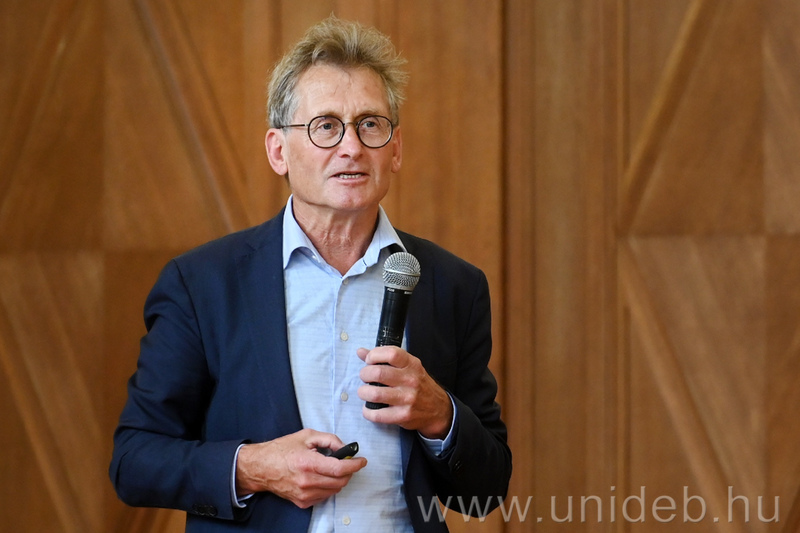
Bernard L. Feringa, Nobel Prize-winning chemist, opened the 20th International Conference on Chiroptical Spectroscopy, which after twenty-two years was once again organized in Hungary, this time at the University of Debrecen. The four-day conference presents the latest chiroptical techniques for studying the spatial structure of organic molecules and their applications, with renowned researchers from all over the world.
Chiroptical spectroscopy is a structural analysis method that examines the interaction between chiral, non-racemic substances and polarized light, thus determining their spatial structure. According to one of the best-known chemists in the field, chirality is the imprint of life itself. – “Life-essential biopolymers, DNA, proteins, and carbohydrates all exist in mirror-image forms, of which overwhelmingly only one is present in living organisms. Life could not exist without them. It remains a mystery, and a matter of much debate, what caused the dominance of one form in living systems. At this conference, we have been debating this question for decades, giving lectures on the fundamental approaches to chirality. Chiroptical spectroscopy is also extremely important for the pharmaceutical and chemical industries, since many chiral drug compounds are marketed in only one stereoisomeric form, as the others may have different, sometimes harmful effects,” said Nobel Prize-winning chemist Bernard L. Feringa to unideb.hu, who came to the University of Debrecen on Monday for the 20th International Conference on Chiroptical Spectroscopy.
The conference, held every two years, originated in Central and Eastern Europe but today is hosted by the world’s largest cities, most recently Hiroshima, and before that New York. This gives special significance to the fact that Hungary is hosting the international event for the third time. – In 1987 it was organized in Budapest by Professor Márton Kajtár, in 2003 by Professors Miklós Hollósy and Sándor Antus, but this is the first time that Debrecen welcomes the field’s most renowned representatives. With the four-day conference, participants also pay tribute to the 100th birth anniversary of Professor Koji Nakanishi, a leading researcher in chiroptical spectroscopy, emphasized Tibor Kurtán, head of the Department of Organic Chemistry at the Faculty of Science and Technology of the University of Debrecen.
Former members of Koji Nakanishi’s research group, who continue to work in this field, were also invited and are commemorating the distinguished scientist in two special sessions. The conference series itself celebrates its 40th anniversary this year, as the first one was held in Sofia in 1985. At the University of Debrecen, chiroptical spectroscopy was introduced by Sándor Antus, former head of the Department of Organic Chemistry at the Faculty of Science and Technology, whose research group has since gained international recognition. Another iconic figure in the field in Hungary was stereochemist Márton Kajtár, whose former student, András Perczel, has also actively contributed to organizing the conference. – “The field is relatively narrow, so as always, around 150 experts have gathered at the conference. It is like a big family, so this meeting is both scientific and friendly, with entire generations growing up here,” summarized András Perczel, head of the Department of Organic Chemistry at ELTE.
The conference’s distinguished speakers were also welcomed at Kenézy Villa on Tuesday by György Kossa, chairman of the board of trustees of the Count István Tisza Foundation for the University of Debrecen, Zoltán Bács, chancellor, and Ferenc Kun, dean of the Faculty of Science and Technology. At the informal meeting, it was emphasized that the institution is always pleased to host such events, which not only enrich students’ knowledge but also support the scientific work of teachers and researchers.
(unideb.hu)