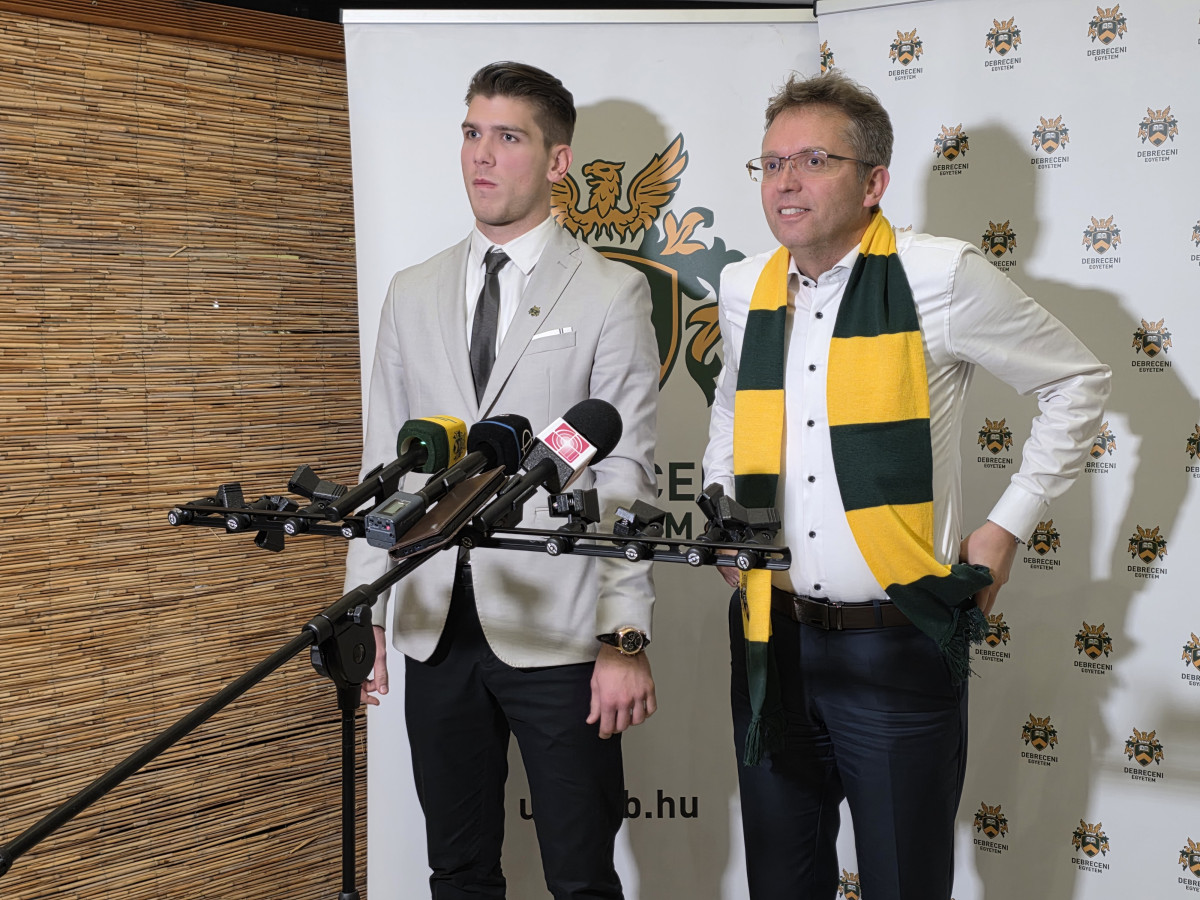
On October 30, Balázs Hankó, Hungary’s Minister for Culture and Innovation, held a student forum at the University of Debrecen. The discussion touched on several sensitive topics — from scholarships and the Pride march to Hungary’s exclusion from the Erasmus program. Below are the most notable exchanges based on the university’s broadcast.
“You’ve never heard that from me” – On scholarships
One student asked when and by how much scholarships would be increased, saying promises had been made for years without results. Hankó responded:
“I would like to achieve a doubling.”
The student pressed further:
“And what does that depend on? Every year we hear there will be an increase, and then nothing happens.”
To which the minister replied briefly:
“You’ve never heard that from me. Trust me a little.”
The student also noted that the 38,000-forint average scholarship Hankó had mentioned earlier didn’t match his experience — in his cohort of sixty students, maybe one received that much.
Hankó explained:
“When you divide the total amount across the large sample, that’s the average. The intersection of how much the scholarships are and how many receive them gives this figure.”
Pride, respect, and government communication
A humanities student criticized the government’s communication on LGBTQ issues, arguing that referring to “LGBTQ propaganda” fuels homophobia. The student said it was important to be able to discuss the issue calmly.
Hankó replied in a personal tone:
“Believe me, it’s not pleasant to read that ‘Hankó the Jerk’ Balázs is coming here to hold a forum. Believe me, it’s not good to read that I’m called an arrogant blowhard. It’s not good for my children to see such things written about their father.”
He added that debate is important, but:
“You can argue, but you must respect each other in the process.”
The student countered that government rhetoric makes life harder for some Hungarian citizens.
“If someone goes to a Pride march, it’s not what the government says it is — it’s a person exercising their rights,” he said.
Hankó asked in return:
“What do you think Pride is?”
The student answered:
“A march of pride. It’s not only for gay people — anyone proud of something can join. Of course, most participants are those with different sexual orientations. It’s not a political issue — that’s the problem.”
Hankó concluded:
“I think one’s orientation, religion, or convictions concern only oneself, one’s environment, and one’s friends. It’s unfortunate that this topic has escalated like this.”
Erasmus vs. Pannónia: “It’s no longer the government’s responsibility”
One of the sharpest debates centered on the Erasmus program. A pharmacy student asked why the government was not fulfilling the EU’s conditions that would allow foundation-run universities — including the University of Debrecen — to rejoin Erasmus.
The student argued that the Pannónia Scholarship Program, Hungary’s Erasmus alternative, offered “fewer and lower-quality” universities than the EU scheme.
Hankó asked:
“And what are the EU’s conditions, in your view?”
The student replied:
“Joining the European Public Prosecutor’s Office.”
To which the minister responded:
“And what does that have to do with universities?”
He added:
“The University of Debrecen is in legal proceedings with the European Commission; the last hearing was in September in Luxembourg. The Commission unlawfully excluded the foundation universities, as higher education is a national competence.”
According to Hankó, the Commission had introduced several new requirements, which the Hungarian Parliament approved, yet the exclusion remained, citing the presence of politicians on university boards of trustees.
“Across all foundations, there are 105 board members in total — 13 were former politicians. They have since stepped down, yet the exclusion continues,” he said.
The minister added that over the past year, 8,115 students had taken part in the Pannónia program, including 500 from the University of Debrecen.
“From here on, it’s not the government’s responsibility — it’s up to each university and its faculties to build these international partnerships. We provide the necessary funding.”
Finally, Hankó concluded:
“I believe students can reach better universities through the Pannónia program than through Erasmus.”