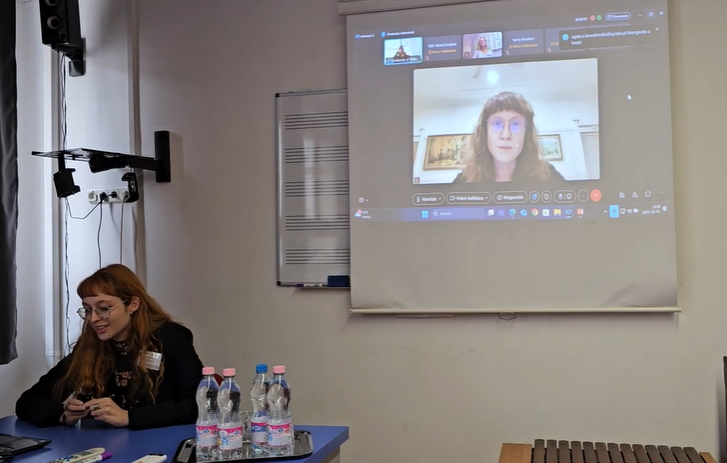
Agata Kowalewska’s recent presentation explored the complex intersections between human and non-human behaviors, particularly in the context of sacred sites where animals and humans coexist. Her talk, “Looking Through the Glass with Macaque: Navigating Disciplinary Borders at a Sacred Site,” offered insights into multispecies interactions and the challenges of understanding intrinsic motivation across species.
Kowalewska opened with a discussion about observing intrinsic motivation in animals, particularly dogs, and how their behaviors reflect internal states rather than external rewards. She explained that through extended cognitive-behavioral training, dogs often develop self-motivated behaviors, which can manifest as calm, relaxed actions or spontaneous choices during walks and interactions. “Intrinsic motivation can be seen when a dog chooses to make a decision on its own, independent of reinforcement,” she noted, emphasizing the importance of emotion preceding observable behavior.
The discussion expanded to consider interspecies variability. Audience members asked how researchers account for differences in behavior between species—such as dogs, cats, and reptiles—especially when signs of discomfort or tolerance vary widely. Kowalewska described her methodology of categorizing responses into “toleration,” “affiliative behaviors,” and “escape attempts,” noting that these categories allow for nuanced interpretation even when behaviors differ significantly across species.
A particularly engaging part of the session addressed macaques at sacred sites. Kowalewska shared her observations over two months, highlighting how these primates pay close attention to human behavior, often monitoring objects, food, and even subtle movements. She stressed that, while macaques are attentive to humans, the aim is not to anthropomorphize them but to respect their perspective. This approach, she argued, allows researchers to learn from the coexistence of humans and animals without imposing human assumptions.
Kowalewska also drew connections to street dogs in Costa Rica, noting that dogs observe human cues such as traffic lights and pedestrian movements to navigate urban environments. She referenced the work of Robin Bering and Jacob Lea on macaques’ ability to make economic decisions, illustrating how animals can selectively interact with humans based on past experience and risk assessment.
Throughout the discussion, Kowalewska emphasized the value of interdisciplinary approaches, blending cognitive science, ethology, philosophy, and anthropology. Her research demonstrates that understanding animal behavior, especially in human-dominated environments, requires both careful observation and respect for the animals’ independent decision-making processes.
The session concluded with audience reflections on ethical considerations, the influence of human families on pet behavior, and the broader implications of observing animals across cultural and environmental contexts. Kowalewska’s work invites us to reconsider how humans engage with other species, encouraging a perspective that balances scientific inquiry with attentiveness to the lived experiences of animals.