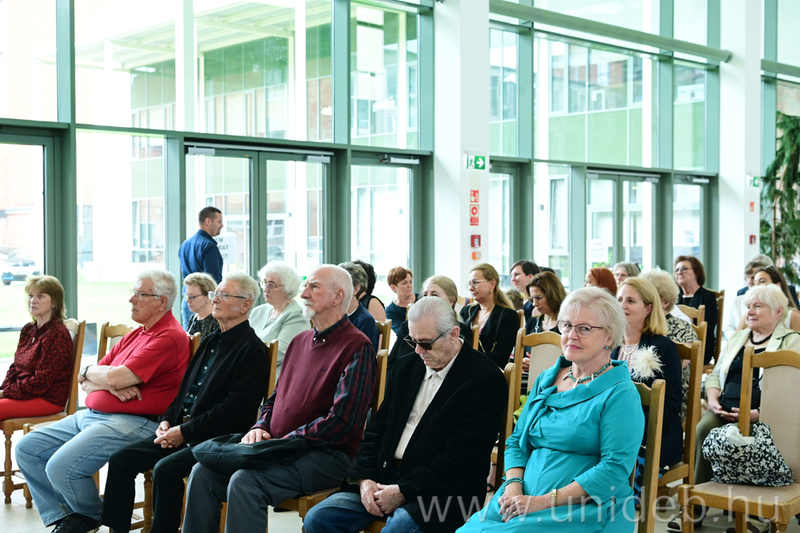
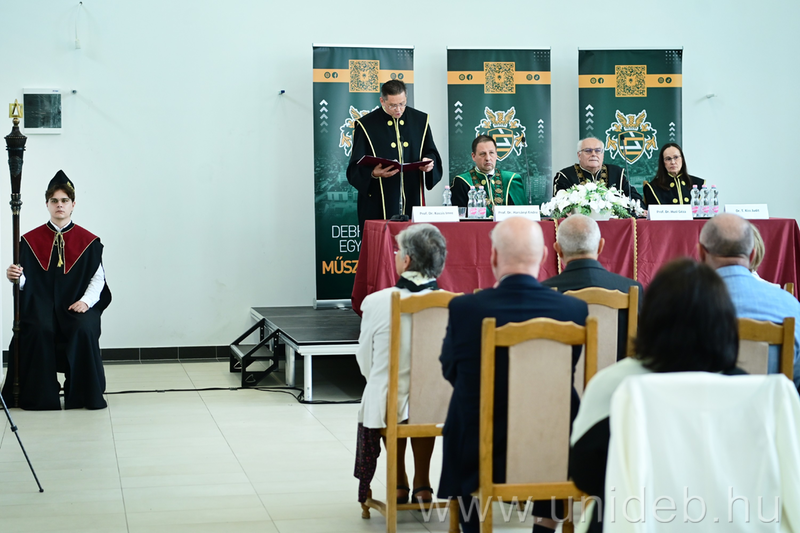
Engineers who earned their degrees in 1976 from the predecessor institution of the University of Debrecen’s Faculty of Engineering, the Faculty of Civil Engineering of the Ybl Miklós Technical College, received Golden Jubilee Diplomas at a ceremony on Thursday. A total of 58 former students were honored.
Over the fifty years since their graduation, the University of Debrecen Faculty of Engineering has undergone tremendous transformation. Dean Géza Husi noted during the ceremony that more than a decade ago, new lecture halls were created on the Ótemető Street campus in place of former mechanical and architectural laboratories. Three years ago, a major renovation and expansion of the campus began, and the very wing where the honored graduates once studied is currently being refurbished.
Husi recalled that while fewer than 200 students attended Ybl Miklós Technical College in 1976, the Faculty of Engineering now has more than 3,100 students, including around 1,000 international students. Today, the faculty offers eight bachelor’s and twelve master’s degree programs.
“In addition to sports engineering, electrical engineering and mechatronics, we also offer programs in environmental engineering, technical management and professional pilot training. The former building services engineering program has been replaced by a general mechanical engineering program,” the dean explained.
The faculty currently employs around 150 staff members, including 100 academic instructors. Husi added that over the past decade, the faculty has been able to appoint professors who were educated within its own programs.
According to the dean, the faculty has developed significantly over recent decades and has now caught up with—and in some respects surpassed—many of Hungary’s traditionally leading engineering institutions. International rankings that evaluate nearly 20,000 higher education institutions worldwide currently place the Faculty of Engineering around 560th globally. Its annual budget exceeds HUF 3 billion, with an increasing share generated through industry contracts. The faculty cooperates with numerous companies operating in Debrecen, including BMW.
Vice Dean for Scientific Affairs Imre Kocsis highlighted that the faculty’s research performance has steadily improved since it became a university faculty in 2007, with particularly rapid progress over the last decade. The faculty has launched its own doctoral school, publishes prestigious academic journals, hosts an increasing number of professional conferences and events, and continues to expand its scientific publication output.
Following the presentation of the commemorative diplomas, Sándor Horváth spoke on behalf of the graduates of the structural engineering program.
“We attended an excellent school, had outstanding teachers, and received training in a profession that has since become a shortage occupation. Most of us were able to build satisfying professional careers, and we can still be proud of that after all these years,” Horváth said.
Representing the building services engineering graduates, Tibor Csonka reflected on a generation that grew up during the era often referred to as “goulash communism,” when there were no mobile phones or internet, but strong community ties and mutual respect connected people.
“We have many wonderful memories associated with this institution. We hope that when today’s students look back on their university years fifty years from now, their alma mater will inspire the same positive feelings that we are experiencing today,” Csonka said.
(unideb.hu)