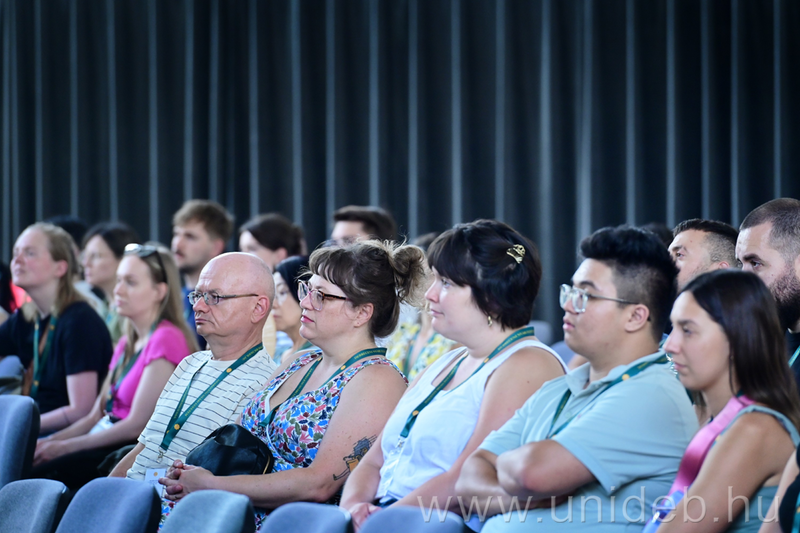
A total of nearly 100 students from 31 countries are exploring the Hungarian language and culture at this year’s Debrecen Summer School. The course, running from July 20 to August 14, welcomes students ranging in age from 15 to 80. During the official opening ceremony held at the University Church on Monday, scholarship certificates were also presented to participants.
The main focus of the course is, as always, the Hungarian language. Classes are offered at all levels, from beginner to advanced, and students completed their placement tests in the weeks leading up to the programme.
Péter Szaffkó, director of the Debrecen Summer School, highlighted that the institution has been serving Hungarian language and culture for nearly a century. Founded in 1927, it is still considered the largest Hungarian school of its kind.
“The Debrecen Summer School fulfils a mission that contributes significantly to friendship and mutual understanding between nations. Although students arrive from many different places to become part of this special community, they all share an interest, affection or deep commitment to the Hungarian language and culture. At the same time, each of them has their own individual goals,” the director said.
The majority of the 93 students participating this year are native English speakers, arriving from Canada, the United States, Australia and the United Kingdom. Ten students speak German as their first language, another ten speak Slovak, while ten participants come from Asian countries. The five students each arriving from Poland and Slovenia are mainly Hungarian studies students or teachers who received scholarships. This year, three participants from Mexico are also taking part in the course.
The summer school’s partner is the Hungarian Reformed Diaspora Centre. Director Attila Kocsis explained that the institution’s mission includes researching the Hungarian diaspora and preserving historical documents that have been discovered.
“There are 2.5 million people of Hungarian origin living beyond the borders, in Western Europe, North and South America, as well as in Israel. We would like to present examples to future generations that they can learn from and draw inspiration from,” he said.
The Debrecen Summer School was founded by three professors of the Faculty of Humanities of the University of Debrecen, and the close relationship between the two institutions has remained strong ever since, said Károly Pető, rector’s commissioner of the University of Debrecen, in his welcome speech.
“For a century, the Debrecen Summer School has built bridges between Hungary and the world through language and culture. Today, the university has 13 faculties and 35,000 students, with educational programmes covering almost the entire spectrum of academic disciplines. We believe that, alongside science, mutual respect, openness and dialogue are what make a university great. Those who learn a new language discover a new culture. Every culture we get to know brings us closer to one another,” he emphasised.
The Faculty of Humanities also works during the autumn and spring semesters to introduce international students to the unique characteristics of the Hungarian language, as well as the history of Hungary and Debrecen.
“In the past three years, more than 100 international students have studied in bachelor’s and master’s programmes at the Faculty of Humanities. It is encouraging that this number continues to grow, partly thanks to the close cooperation between the summer school and the faculty. The faculty also supports participation in the summer school through scholarships,” said Levente Takács, deputy dean for general and educational affairs of the Faculty of Humanities.
István Puskás, deputy mayor of Debrecen responsible for culture, recalled his experiences as an instructor at the summer school and recommended some of the city’s most important cultural institutions and attractions to the students.
“The Debrecen Summer School is also an important part of the city’s cultural life. Get to know Debrecen, its cultural heritage, the Déri Museum, MODEM, and the Campus Festival, which begins this week,” he encouraged the participants.
During the month-long summer programme, some students will attend the full four-week course, while others will join either during the first or second two-week session. In the first two weeks, seven groups, and in the second two weeks, ten groups will study Hungarian from beginner level to advanced and near-native proficiency.
The opening ceremony at the University Church was enriched by an organ performance by Dániel Sárosi. Scholarships for this year were also presented. Twenty students received Tempus scholarships, while nineteen students were awarded local scholarships from the City of Debrecen, the Rector of the University of Debrecen, the Dean of the Faculty of Humanities, the Bishop of the Reformed Church District of Tiszántúl, and the director of the Summer School.
The courses started on Monday morning. Students attend language classes in the mornings, while afternoons are filled with various cultural and leisure activities. As part of the traditions, every Monday is dedicated to folklore: students not only taste dishes from different regions but can also learn traditional folk songs and dances. Fridays focus on gastronomy: during the “beach party”, participants can try lángos and learn how to prepare pickled cucumbers. Excursions are also an essential part of the programme: in Sáránd, students can make traditional spiral noodles and prepare a wedding menu; at the open-air museum in Nyíregyháza, they can take part in village games; and they can also make their own ointments at a local pharmacy.
The Debrecen Summer School will celebrate the 100th anniversary of its foundation next year. To mark the occasion, organisers announced that they are preparing a conference on Hungarian as a foreign language together with the University of Debrecen.
(unideb.hu)