Participants of a conference in Oradea had the opportunity to observe live catheter-based interventions performed at the Cardiology and Heart Surgery Clinic of the Clinical Center, University of Debrecen. The Hungarian-Romanian professional forum, and the practical course preceding it, highlighted the latest minimally invasive techniques for treating complete coronary artery occlusions.
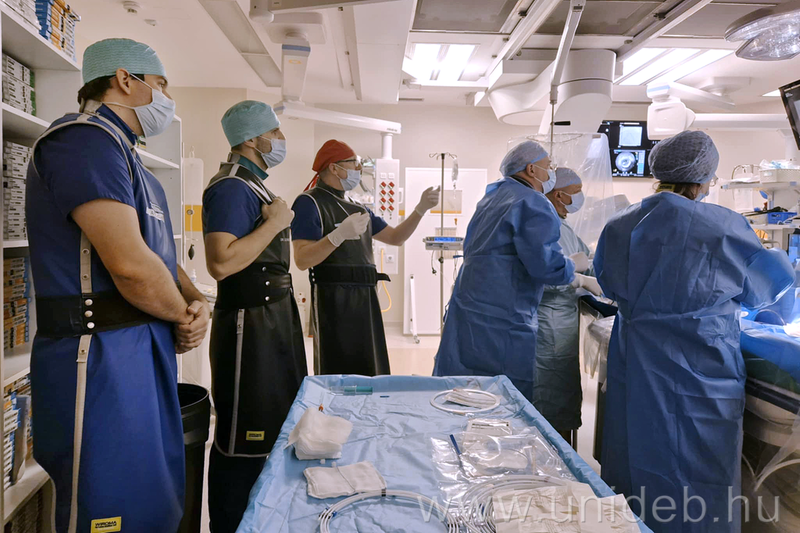
During the practical course held on November 14–15 as part of the second Romanian-Hungarian CTO Workshop, staff from the clinic performed an orbital atherectomy, which attendees could follow directly from the operating room. The procedure uses a specialized device consisting of an electrically powered control unit and a rotating burr that moves in an orbital path, with a diamond-coated abrasive crown at its tip. The crown is introduced into the narrowed artery section, where it gradually sands down calcified deposits on the vessel wall. These particles break into tiny fragments and are flushed out by the bloodstream.
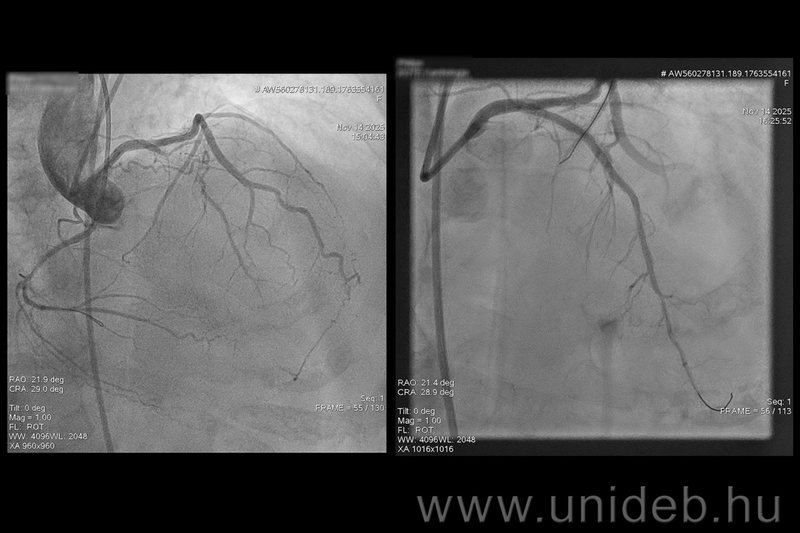
“This is a specialized procedure for treating calcified coronary artery stenoses. It is one of the most complex and challenging percutaneous coronary interventions, as it involves making a hard, often long-standing blockage passable. In Hungary, this procedure was first applied 3–4 years ago, including at the University of Debrecen Clinical Center, where we now perform 15–20 such interventions annually,” explained Tibor Szűk, adjunct physician at the clinic.
Over the two-day congress, the clinic team also performed two catheter-based interventions for chronic total coronary occlusions (CTO). Dr. Szűk and Dr. Ferenc Győry conducted the procedures in a state-of-the-art hybrid lab, inaugurated in 2024. The operations were broadcast live to the congress venue in Oradea, allowing the professional audience to follow the procedures in real time.
“Our team has significant internationally recognized experience in both orbital atherectomy and CTO interventions and has previously been actively involved in teaching our Oradea colleagues. We are frequently invited to high-level international CTO congresses and often perform live-transmitted procedures,” added Dr. Szűk.
Approximately 150 professionals attended the interactive practical course, primarily Romanian and Hungarian interventional cardiologists. Among the international participants, a total of 22 nations were represented, including countries across Europe, as well as Mexico and South Africa.
(unideb.hu)