


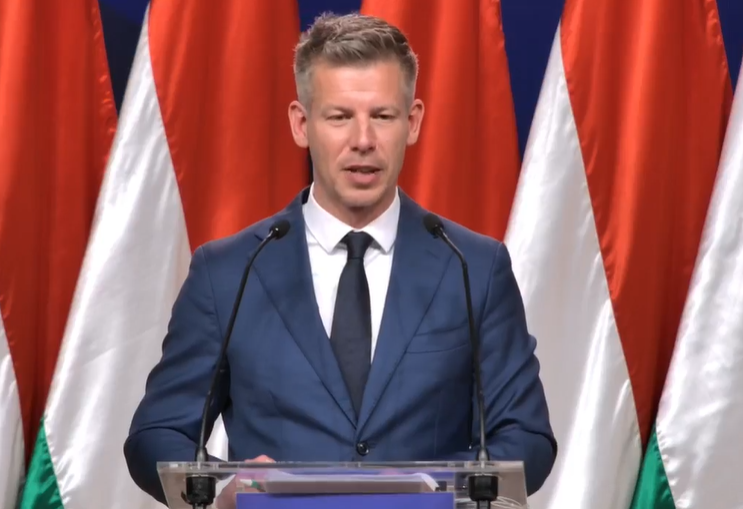
Following the 2026 Hungarian parliamentary election, Péter Magyar, leader of the victorious Tisza Party, outlined sweeping plans for a restructuring of government, a stronger focus on anti-corruption measures, and a new political style he described as bringing decision-making closer to citizens.
Speaking at an international press conference in Budapest on Monday at the Hungexpo Congress Center, Magyar said the incoming Tisza government would replace the current system of “super-ministries” with a structure based on specialized ministries.
“Under the Fidesz government there were super-ministries; in the Tisza government there will be specialist ministries,” he said.
According to Magyar, the new cabinet structure would include separate ministries for healthcare, education, environmental protection, and rural development. He also announced the creation of a “clean finance ministry,” where economic policy would be separated from traditional treasury functions and integrated with both domestic and foreign economic strategy.
He added that a dedicated Prime Minister’s Office would be established, while certain intelligence and security functions would be reorganized across ministries: parts of the intelligence services would be reassigned to the Ministry of Interior and the Ministry of Foreign Affairs.
Magyar also indicated that several ministerial appointments were already known, naming András Kármán and Zsolt Hegedűs, while saying further names would be announced in the coming weeks. He emphasized that his government would rely on “experts, not voting buttons or puppets.”
“Bringing politics back to the people”
In another key message, Magyar said the new government would aim to fundamentally change how politics operates in Hungary.
“We see politics as service, and we will bring politics back to the people,” he said.
He added that the Tisza government would involve citizens directly in decision-making through tools such as referendums and online consultations focused on concrete policy questions.
Anti-corruption agenda and rule-of-law reforms
Magyar highlighted that one of the first priorities of the new government would be the introduction of strong anti-corruption measures. These include initiating Hungary’s accession to the European Public Prosecutor’s Office and establishing a National Asset Recovery and Protection Authority.
He also said constitutional changes would be introduced to limit the prime minister’s time in office to a maximum of eight years.
According to Magyar, restoring the rule of law, democratic pluralism, and checks and balances would be central to the government’s mission.
“Hungary will be a peace government”
Magyar emphasized that Hungary does not want war and will position itself as a “peace-oriented government.”
“The Tisza government will be a government of peace,” he said.
He accused outgoing Prime Minister Viktor Orbán of using war-related rhetoric to maintain power, and argued that Hungarian voters had rejected such messaging in favor of domestic issues such as healthcare, education, and living standards.
He also stressed that Hungary would act as a constructive partner within the European Union while consistently representing Hungarian interests internationally—in Brussels, Washington, Berlin, Moscow, and Beijing.
Early post-election situation and parliamentary majority
Magyar stated that, according to current results, the Tisza Party is set to hold 138 seats in the 199-member National Assembly. He added that with approximately 400,000 remaining votes still to be counted from overseas and absentee ballots, the party could gain additional seats, potentially reaching 141–142 mandates.
He described the election result as a “historic mandate,” saying Hungarian voters had delivered a strong two-thirds majority for change.


