
Companies that fail to meet compliance expectations and do not follow the law can expect to lose their reputation and face serious fines — this emerged at the III. Compliance Conference held on Wednesday, organised by the Count István Tisza Foundation for the University of Debrecen and the University of Debrecen. Conference participants were shown several practical examples illustrating cooperation opportunities and benefits aligned with the spirit of compliance.
In the Aula of the Main Building of the University of Debrecen, before an audience of 250 professionals and interested parties, György Kossa, chairman of the board of the Count István Tisza Foundation for the University of Debrecen, said that compliance — meaning law‑abiding behaviour, transparency and an ethical operating culture — is no longer simply the task of a corporate department; the concept goes beyond administration and regulations.
“Compliance has become the internal compass of responsible organisations of the future. It is a set of values that underpins public trust, the integrity of the economy, and ultimately the competitiveness of the nation. As the intellectual centre of the region, the University of Debrecen leads the way in teaching, researching, and practically reinforcing this mindset. As the foundation that supports the institution, this is not merely a strategic objective for us, but a mission. We support knowledge and collaborations that shape the moral and professional quality of society in the long term,” said György Kossa.

Zoltán Bács, Chancellor of the University of Debrecen, emphasised that the institution now approaches 50,000 members and carries out diverse activities from education and healthcare provision to research and development, company operation and manufacturing.
“If there were no regulation, rigorous requirements and transparency here, we would certainly be in trouble as an organisation. This also proves that the topic of compliance needs to be addressed with priority. Compliance and trust‑building are important not only for economic actors but also for the university,” said Zoltán Bács.
From the presentation by Chief Prosecutor Gábor Bálint Nagy it became clear that criminal procedure law and corporate compliance are not far apart.
He drew attention to a unique supplementary private‑prosecution instrument available in Europe that has been applicable since January 2023; its aim is to curb corruption and to protect public funds and the integrity of economic competition.
The President of the Hungarian Competition Authority (GVH) stressed that the GVH is the guardian of fair competition while also acting to ensure consumer rights. They also consider developing a culture of competition an important task.
“It is in our interest that companies progress in compliance. That is why, for example, we regularly publish practical, informative guides with examples that help businesses comply with regulations,” added Csaba Balázs Rigó.
According to the head of the GVH, a growing problem today on social media is that highly followed influencers often do not inform their viewers when they are advertising a product or service.
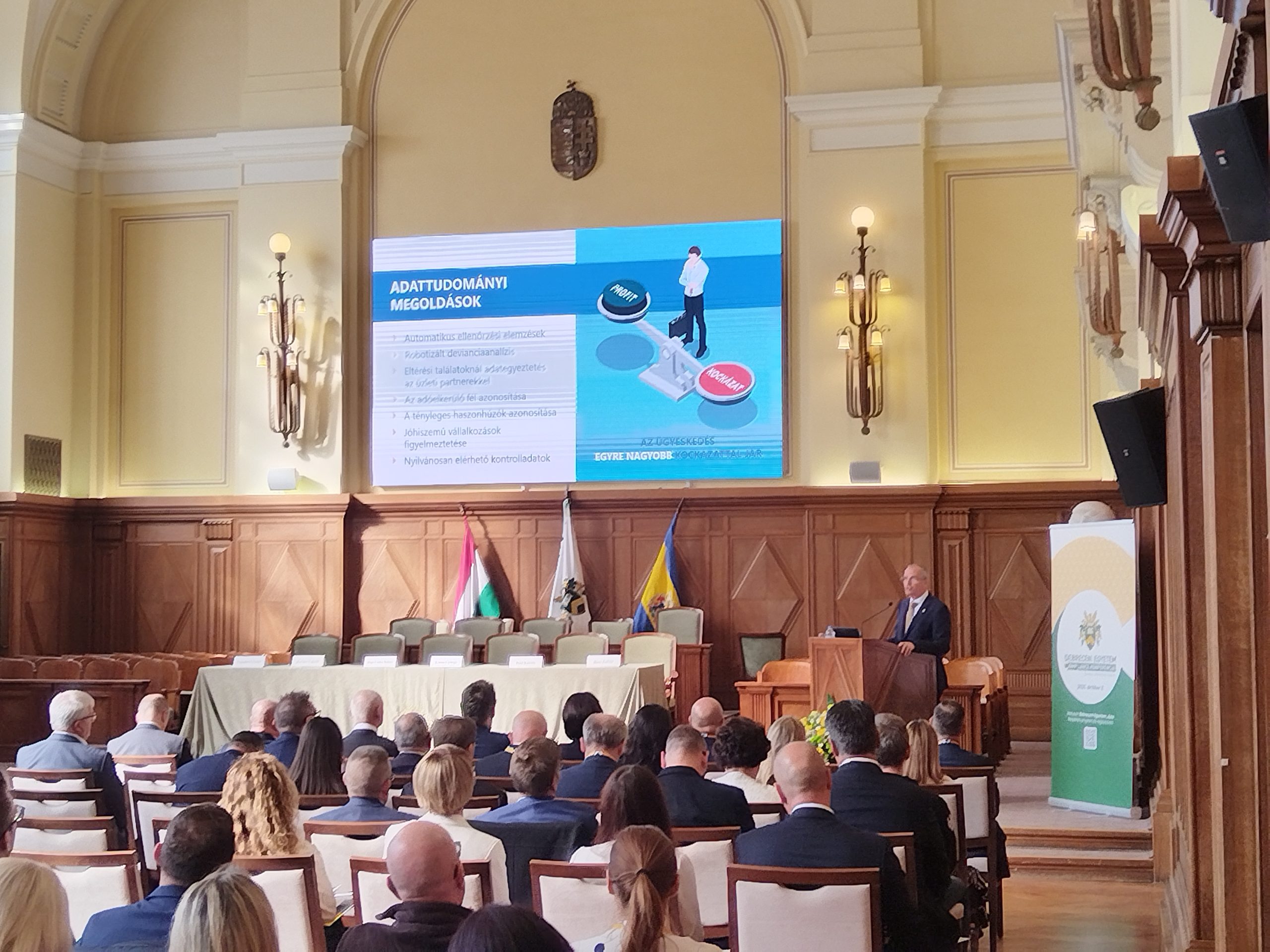
Ferenc Vágujhelyi, President of the National Tax and Customs Administration (NAV), pointed out in his presentation that NAV’s main tasks include not only tax collection but also ensuring conditions for fair competition, which they sometimes secure using administrative and, where appropriate, investigative or criminal tools. Their data processing system is not accessible from outside.
Because virtually every economic activity now leaves a digital trace, NAV conducts its compliance work in a data‑driven manner, Vágujhelyi shared.
Zsuzsanna Herman, the University of Debrecen’s Director of Compliance, explored what organisations need to consider if they want to use AI systems.
“The emergence of artificial intelligence does not merely represent technological progress, it opens a completely new era from a compliance perspective. This unstoppable development certainly has advantages such as efficiency, automation and improved problem solving. But it also has downsides, such as lack of transparency and legal uncertainty in this area,” Herman explained.
She added that last year the European Union adopted the world’s first regulation to govern artificial intelligence, creating a legal framework for developing, deploying and marketing AI. The EU did this to ensure safety and fundamental rights.
“The question is not what AI is capable of, but what we allow it to do,” Herman emphasised.
Tamás Bendik, Deputy President of the National Authority for Data Protection and Freedom of Information, analysed the situation of domestic micro, small and medium‑sized enterprises in light of current data protection standards. He concluded that it is quite a challenge for these companies to learn the regulatory environment and comply with requirements. At the same time, for lawyers the SMEs are primarily data controllers and processors. Among these, firms that use compliance can gain a competitive advantage because clients’ trust is stronger in such companies, Bendik said.
László Kovács, President of the Public Procurement Authority, reported at the conference that in Hungary an average of 8,000 public procurement procedures close each year with contract awards, during which almost HUF 3,000 billion of public money is spent.
“These funds must be used efficiently, competitively and transparently. To make that happen, we try to provide every possible support,” the expert stressed.
Kovács announced that suppliers who regularly participate in public procurements will in future be awarded gold, silver and bronze certifications.
Attila Korencsi, Compliance Director at the Hungarian National Bank, explained that capital is steered towards stable enterprises that comply with laws — that is, towards companies that keep compliance goals in mind and adapt flexibly to current challenges. He also noted that the University of Debrecen’s commitment to compliance is demonstrated by the launch last year of specialist legal and compliance training at the Faculty of Law, and that the second academic year is already under way.
A scientific adviser commissioned by Wolters Kluwer gave a presentation on the value of corporate compliance in competition — how it can become a factor strengthening competitiveness and an important element of corporate culture. Judit Firniksz observed that compliance now appears already during the development of business models, products and services. She argued that this formerly professional field is gradually growing into a scientific discipline.
Csaba Polacsek, partner at PricewaterhouseCoopers Hungary Ltd., presented the results of an American study that examined more than a thousand global cases in which employees carried out financial fraud at companies. They found that 74% of such offenders are well‑educated men aged 30–50, and the longer someone works at a company, the greater the value of the fraud they may commit. Where compliance is applied, the chance of such incidents is much lower, Polacsek emphasised.
The Compliance Conference was closed with a roundtable discussion chaired by Zsuzsanna Herman, the university’s compliance director. In the discussion, András Kiss, head of economic development and innovation at the Hajdú‑Bihar County Chamber of Commerce and Industry, said from his experience that large corporations have long followed a rule‑compliance philosophy, whereas for many small and medium enterprises it is either new or they do not realise that what they do already falls under compliance. He added that this is needed for growth. Csaba Bús, head of Business Compliance Control at OTP Bank, said that it is in the interest of financial institutions to comply with requirements in every respect. For systems to function well, banks need compliance organisations. “Today it’s an extra; in five years it will be standard,” he said.
István Bálint Gerencsér, head of Richter Gedeon’s global compliance group, argued that strict legal compliance can play a risk‑reducing role and help business deals because it is easier to earn and maintain partners’ trust. Dóra Dékány, whistleblowing liaison at the Hungarian Bar Association and an attorney, added that while in American films of the 1980s and 1990s deals were often struck with the man who could drink the most in a pub, today transparent corporate operation has become far more important.
Attila Kámán, Director of MBH Bank, observed that younger generations are much more aware of what compliance is and of its benefits than older people. In the banking sector it is particularly important to gain clients’ trust, so banks also need it, he stressed. Chancellor Zoltán Bács reported that the university also takes care in selecting business partners; for example, before establishing a new corporate relationship they check the company in various reliable registries. As demand grows, he believes more such certificates and ratings will surely appear.
Antal Ratku, vice‑president of the Hajdú‑Bihar County branch of the Hungarian Chamber of Auditors, reminded the audience that the purpose of auditing is to check whether the figures in a company’s reports correspond to reality and to provide owners with an accurate picture of the company’s assets and financial situation. Thus, credibility is important for auditors as well.
Adél Molnár, data protection officer and attorney at the Hungarian Bar Association, warned that more and more employees use unauthorised AI tools at work, for example to prepare presentations. This exposes companies to serious risks because the data in AI is not always accurate, and users may upload personal, confidential or trade‑secret information while using these tools. György Kossa, chairman of the Count István Tisza Foundation for the University of Debrecen, relatedly emphasised that companies should consider banning the use of artificial intelligence on their electronic devices because these tools can be exploited to breach security. It is even possible to create profiles on individuals that could be used to blackmail the person or the company.
(unideb.hu)