


“My degree is in chemistry, but as the saying goes, I’ve never been a hanging man. Currently, I only work on the Vadvirágom project with our growing small team, but I’ve done everything from reception work to teaching Norwegian, and even guiding whale-watching tours. One thing is certain: nature always pulls me back and captivates me with new wonders,” says Zita Török. As I read this introduction, I knew I had to talk to her.
The first question was easy: the mention of whale tours was like chocolate for someone with a sweet tooth. Zita’s journey began with a scholarship to Norway, and she almost didn’t stop until reaching the Arctic Circle, where she felt at home. She studied and worked in Norwegian, living there for nearly six years before pursuing another dream in South America.
“I started in Peru; the rainforest was my goal, then Chile followed. Since my money started running out, I camped and hitchhiked – but everything always worked out. I met a Slovenian couple who had a secret whale-watching spot. They were planning a tourism business but needed someone to stay on site. I stayed.” This is how the company Zita poured her heart and soul into for a year and a half was born – on the edge of the Atacama Desert, by the Pacific Ocean, in a tiny fishing village. Thanks to the Humboldt Current’s cold, oxygen-rich water, whales could be easily seen and heard, returning regularly during part of the year. “It was an amazing place. I went from an Arctic fishing village to a desert fishing village,” she recalls. She spent half the year in Chile and the other half in the Netherlands with her partner. Eventually, she felt it was time to move on, so she sold her share in the company – in February 2020. In March, what nobody expected happened: the pandemic. Miraculously, Zita and her partner returned to Hungary in just six days.
Restarting – with Wildflowers
The next stop was Majosháza, more precisely the family holiday home. This marked the beginning of a new chapter. Zita began teaching Norwegian online but also returned to something that had fascinated her since childhood: the world of flower seeds. “Like many during COVID, I started a vegetable garden and watched gardening videos. That’s how I discovered pollinator-friendly gardens. I realized how urgent the issue is and how little information is available locally. When we moved into our own little house, I began applying what I had learned in practice.”
Zita doesn’t only focus on bees. Hungary is home to thousands of pollinator species, not just honeybees. Her goal is to create attractive, livable gardens for all of them – using native wildflowers. But she quickly realized that there was no source for high-quality, targeted seed mixes. “Eighteen months of research began. I studied species, collected seeds, experimented.” This is how Vadvirágom started, filling not only a market gap but an ecological need.
Becoming a Gardener – for Pollinators, Children, and Birds
While expecting her second child, Zita thought she would slowly build her business. But things turned out differently. “By March 10, 2024, exactly on Pollinators’ Day, everything was ready. The reception was incredible. What was planned as ‘I’ll do it gradually’ became a real business in no time. Now a whole team works behind Vadvirágom.”
Most of the seeds come from Hungarian producers and collectors, with Zita often collecting wildflowers herself along the Danube. International supplements come from suppliers in the Netherlands, Germany, and Poland. She tests every mix in her own garden, performing detailed trials to provide practical advice to customers. “Wildflowers behave differently from garden flowers. Many can be sown in autumn but only sprout in spring. Flowering takes patience – sometimes one to one and a half years. That’s why I always include some annuals in my mixes so there’s immediate joy and blooms in the first year.”
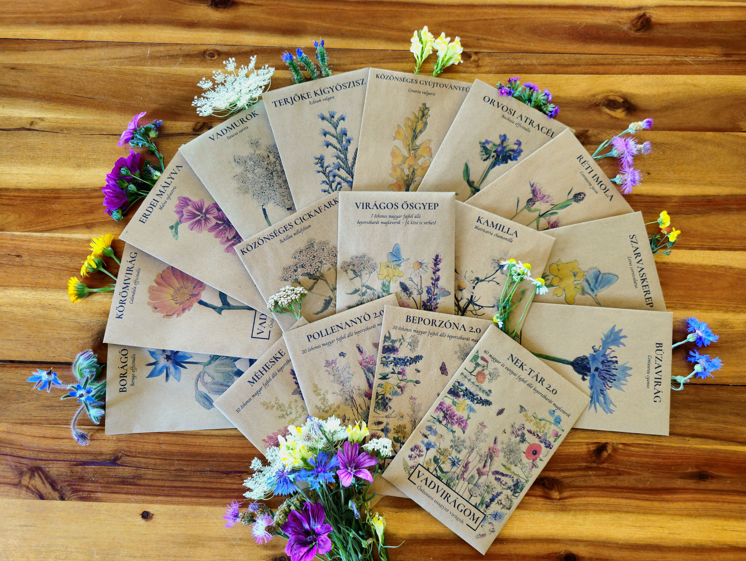
Vadvirágom offers a colorful, creative, and inspiring range: the “Bird-Attracting Mix” provides a flower meadow for pollinators and food for birds in winter. The “I’ll Be a Gardener” mix is designed for children – free of toxic plants and suitable for balcony planters.
And It Doesn’t End There
Zita is full of new ideas: she’s working on edible flower mixes, extra-low-growing wildflower mixes, and constantly monitors demand. Vadvirágom has become more than just an online store; it’s a community where people who believe in sustainable, nature-friendly gardening with flowers, bees, and birds can connect, whether in a small garden or just a balcony planter.
– Translated from the article by Bea Szöőr –
The Hungarian-language version of the interview with Zita Török can be read here.
Photo: Zita Török


